

If you’ve spent any time in Coeur d’Alene, Post Falls, or Hayden lately, you’ve probably noticed a lot of evergreen trees, and a lot of Washington license plates.
While North Idaho has always been a favorite destination for our neighbors to the west, the “trickle” has turned into a flood. As a REALTOR® licensed in both Idaho and Washington, I’m hearing the same thing from clients every day: “We love Washington, but the math just doesn’t work anymore.” A lot of people are now relocating from Washington to Idaho because of these new taxes.
From shifting tax landscapes to the desire for more breathing room, here is why relocation to North Idaho is the move of the year for Washingtonians.
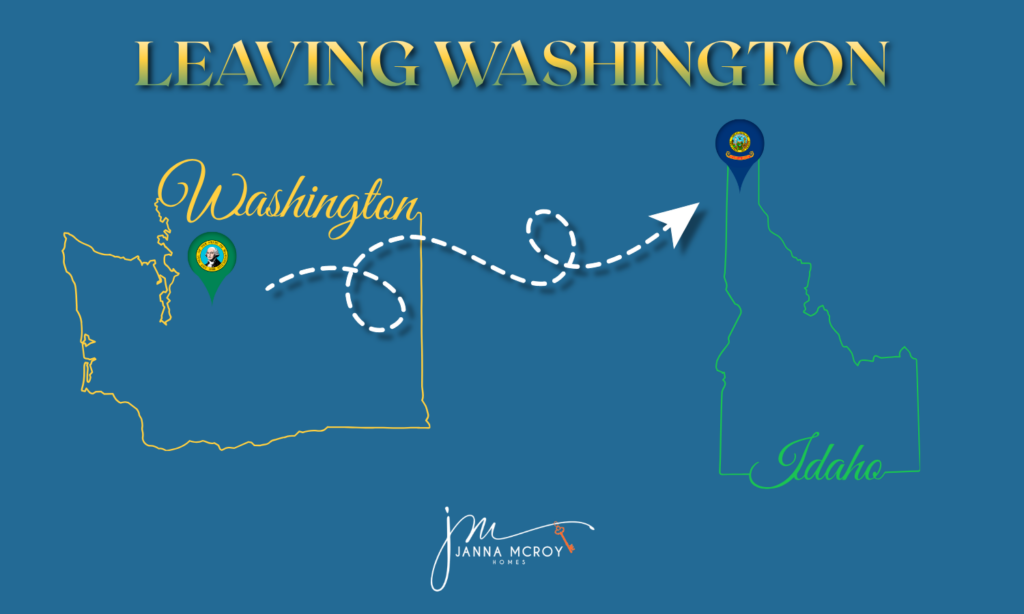
The “Tax Cliff”: Why Washington’s Math is Changing
For decades, Washington’s “no income tax” status was its biggest selling point. But in 2026, that landscape looks very different. Recent legislative shifts have many residents feeling the squeeze:
- The Capital Gains Tax Hike: As of 2025, Washington implemented a graduated Capital Gains Tax that hits 9.9% for gains over $1 million. For business owners and investors looking to cash out, this is a significant “exit fee.”
- The “Millionaires’ Tax”: The newly passed SB 6346 introduces a 9.9% tax on high earners. For many, the “no income tax” shield is officially gone.
- Estate Tax Pressures: Washington currently has some of the highest estate tax rates in the country, topping out at 20% (and briefly hitting 35% before recent adjustments).
The Idaho Advantage: Idaho offers a predictable 5.3% flat income tax. For those moving from the Puget Sound, the simplicity and lower top-end rates mean keeping more of your hard-earned equity and retirement savings.
Equity Preservation: Your Money Goes Further
If you’ve owned a home in the Seattle or Bellevue area for more than a few years, you’re likely sitting on a mountain of equity. Relocating to North Idaho allows you to “unlock” that wealth.
In North Idaho, that same equity often buys you:
- Twice the Acreage: Instead of a small suburban lot, you could have 5+ acres in areas like Sagle or Athol.
- Newer Construction: Many buyers find they can move from an older, high-maintenance home into a modern, energy-efficient custom build and still have cash left over.
- Lower Property Taxes: While Washington’s property tax growth caps have expanded, Idaho’s property taxes remain famously manageable, especially for primary residences with the homeowner’s exemption.
The “183-Day Strategy”
With remote work now the norm for many tech and professional services roles, the physical “tie” to a Washington office has snapped. Many of my clients are utilizing the “183-day rule”, establishing primary residency in Idaho to legally and ethically pivot their tax liability to a more favorable state.
Lifestyle: A Slower Pace, Not a Lesser Life
It isn’t all about the money. People are relocating from Washington to Idaho for the “North Idaho Soul.”
- Freedom and Values: There is a palpable sense of community and personal freedom here that resonates with people looking for a change from the dense urban environments of the coast.
- The Great Outdoors: From boating on Lake Coeur d’Alene to skiing at Schweitzer, the recreation here isn’t a “weekend trip”, it’s your backyard.
Ready to Make the Move?
Making a cross-border move involves more than just a moving truck; it requires a strategic plan to coordinate the sale of your Washington property with the purchase of your Idaho home.
Because I am dual-licensed in Idaho and Washington, I help my clients navigate both sides of the state line seamlessly. We can plan your exit and your arrival with one cohesive strategy.
Considering a move from WA to ID? Connect with Janna McRoy today to see how much you could save, and how much you could gain, by heading east.
Disclaimer: I am a real estate professional, not a tax advisor. Please consult with a CPA or tax attorney regarding the specific impacts of Washington and Idaho tax laws on your personal situation.
Frequently Asked Questions
Generally in 2026, yes. While home prices in North Idaho have risen, the overall cost of living remains lower due to Idaho’s 5.3% flat income tax rate and manageable property taxes. In contrast, Washington has introduced new capital gains and high-earner taxes that have changed the financial math for many residents.
As of 2026, Washington’s capital gains tax (9.9% on gains over $1 million) can significantly impact business owners or investors looking to sell assets before moving. By establishing residency in Idaho, often referred to as the “183-day rule”, many movers are able to pivot their tax liability to Idaho’s more predictable flat-tax system.
The 183-day rule is a residency requirement used to determine which state has the right to tax your income. To be considered an Idaho resident for tax purposes, you typically need to maintain a home in Idaho and spend more than half the year (183 days) within the state. This is a common strategy for remote workers looking to legally transition their primary residency away from Washington.